

The automotive wiring harness is the main body of the automotive circuit network. Without the wiring harness, there would be no automotive circuit.
A wire harness refers to a component that connects circuits by crimping contact terminals (connectors) made of copper materials with wires and cables, and then plasticizing insulators or adding metal shells on the outside.
The wire harness industry chain includes wires and cables, connectors, processing equipment, wire harness manufacturing and downstream application industries. Wire harnesses have a wide range of applications and can be used in automobiles, household appliances, computers and communication equipment, various electronic instruments and meters, etc. The body wire harness connects the entire vehicle body and is generally in an H shape.
Introduction
Automobile wires, also known as low-voltage wires, are different from ordinary household wires. Ordinary household wires are single-core copper wires with a certain degree of hardness. And the wires in cars are all made of copper with multiple cores
Soft wires, some as thin as hair, several or even dozens of soft copper wires are wrapped in plastic insulating tubes (polyvinyl chloride), which are soft and not easy to break.
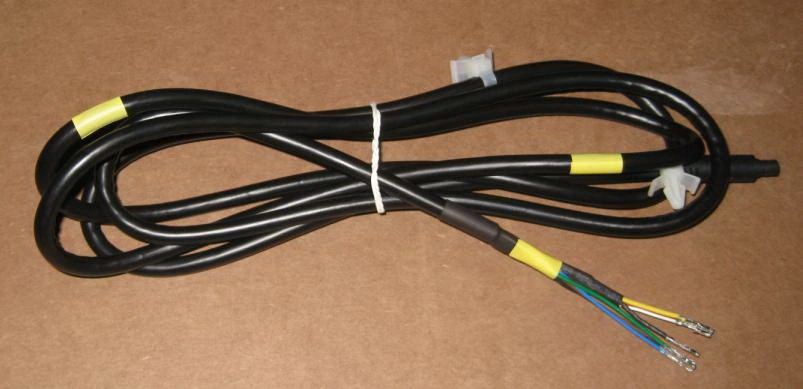
Due to the particularity of the automotive industry, the manufacturing process of automotive wiring harnesses is also more special than that of other ordinary wiring harnesses.
Material
The requirements for materials in automotive wiring harnesses are also very strict:
Including its electrical performance, material dispersion, temperature resistance, etc., all have higher requirements than ordinary wiring harnesses, especially those related to safety: such as wiring harnesses of important components like direction control systems and brakes, the requirements are even more strict.